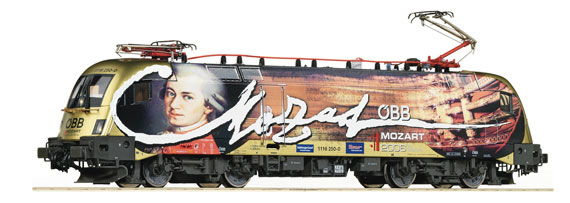
Roco Wolfgang Amadeus Mozart Jubiläumsjahr Taurus E-lok ÖBB 1116 HO DC 2-rail
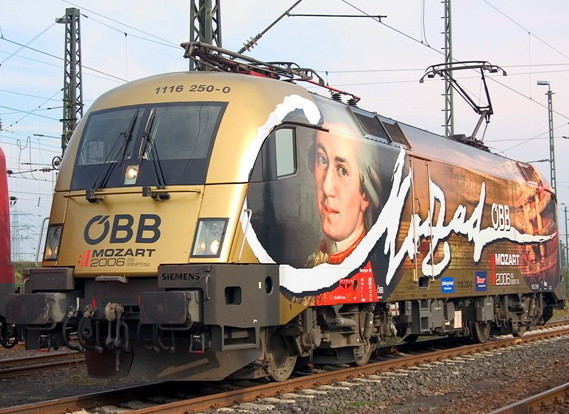
奧地利聯邦鐵路 (ÖBB) 1116 250-0 金牛座電力機車
ROCO 出品的沃夫岡·莫札特紀念版機車
為慶祝偉大的作曲家沃夫岡·莫札特誕辰 250 週年,Modelleisenbahn GmbH 自豪地向您推出這款塗裝精美、獨一無二的電力機車。
精細的模型,配備兩個受電弓、帶飛輪的馬達(運行極其平穩)、三燈式頭燈和紅色 2 號標誌燈。列車長度 221 毫米。這款精美的模型數量極其有限,工廠已售罄。
莫札特紀念版機車旨在紀念莫札特誕辰 250 週年。原型機車將在奧地利和德國各地運行。 Roco擁有此款產品的獨家生產權。
Roco對交響樂的熱情
沃夫岡·阿瑪多伊斯·莫札特(1756–1791)
沃夫岡·阿瑪多伊斯·莫札特,原名約翰內斯·克里索斯托姆斯·沃爾夫岡·西奧菲勒斯·莫札特(1756年1月27日-1791年12月5日),是古典時期一位多產且極具影響力的作曲家。
莫札特自幼便展現出驚人的音樂天賦。他精通鍵盤樂器和小提琴,五歲就開始作曲,並為歐洲皇室演奏。十七歲時,他受聘於薩爾斯堡宮廷擔任樂師,但他並不滿足於現狀,四處遊歷尋求更好的發展機會,同時筆耕不輟學。 1781年,他在訪問維也納期間被薩爾斯堡宮廷解僱。他選擇留在維也納,在那裡獲得了名聲,但經濟狀況卻並不寬裕。在維也納的最後幾年裡,他創作了許多最著名的交響曲、協奏曲和歌劇,以及《安魂曲》的部分章節,這部作品在他去世時尚未完成。關於他早逝的緣由,流傳著許多神話般的傳說。他身後留下了妻子康斯坦茲和兩個兒子。
莫札特博採眾長,從他人身上汲取養分,逐漸發展出一種兼具輕盈優雅與深沉激情的卓越而成熟的風格。他創作了600多部作品,其中許多被公認為交響樂、協奏曲、室內樂、歌劇和合唱音樂的巔峰之作。他是古典音樂史上最歷久不衰的作曲家之一,他對後世西方藝術音樂的影響深遠。貝多芬早期的作品深受莫札特的影響,約瑟夫·海頓曾寫道:“後世一百年內都不會再見到如此天才。”
男高音歌唱家邁克爾凱利在他的回憶錄中這樣描述莫札特的外貌:「他身材矮小,非常瘦削蒼白,擁有一頭濃密的金發,對此他頗為自負。」正如他早期的傳記作者尼梅切克所寫:「他的體格並無特別之處……他個子矮小,除了那雙炯炯有神的大眼睛外,他的容貌絲毫沒有顯露出他的天才。」他的臉部皮膚凹凸不平,這是他童年時期患天花留下的痕跡。有一張莫札特的合成照片,是由四幅同時代的肖像畫拼湊而成。他喜愛優雅的服飾。當凱利回憶起一次排練時,他說:「他身穿深紅色披風,頭戴金邊三角帽,站在舞台上,為樂隊打著節拍。」他的妻子後來這樣評價他的嗓音:「 「他是一位男高音,說話輕聲細語,歌聲也略顯柔和,但一旦受到某種事物的刺激,或需要傾注心力時,便會展現強大而強大而充滿活力時,便會」
莫札特通常長時間辛勤工作,在截止日期臨近時,他會以驚人的速度完成作品。他經常創作草稿和草圖;與貝多芬的作品不同,這些草稿和草圖大多未能保存下來,因為他的妻子在他去世後試圖銷毀它們。他從小信奉羅馬天主教,終生保持天主教信仰。
莫札特生活在維也納音樂界的中心,結識了形形色色的人:音樂家同行、戲劇演員、薩爾茨堡同鄉以及貴族,甚至與約瑟夫二世皇帝也有過一些交情。所羅門認為他最親密的三位朋友是戈特弗里德·馮·雅克因、奧古斯特·哈茨菲爾德伯爵和西格蒙德·巴里薩尼;其他朋友包括他的前輩約瑟夫·海頓、歌唱家弗朗茨·克薩韋爾·格爾和貝內迪克特·沙克,以及其他……圓號演奏家約瑟夫·洛伊特格布。洛伊特格布和莫札特之間有一種奇特的友好玩笑,洛伊特格布經常成為莫札特惡作劇的對象。
他喜歡撞球和跳舞,也養了一些寵物:一隻金絲雀、一隻椋鳥、一隻狗和一匹馬,供他休閒騎乘。他對粗俗幽默有著驚人的喜愛,這在他現存的信件中得以保留,尤其是在1777年至1778年間寫給他表妹瑪麗亞·安娜·特克拉·莫札特的信件,以及他與妹妹和父母的通信中。莫札特也創作了一些粗俗音樂,一系列他與朋友一起演唱的卡農。
Elektrolokomotive ÖBB 1116 250-0 TAURUS
ROCO's Wolfgang Mozart Locomotive
In celebration of the greatest composer - Wolfgang Mozart the birth of 250 years, Modelleisenbahn GmbH proudly present you this unique electric locomotive in glorious livery
Finely detailed model with 2 pantographs. motor with flywheels for extremely smooth operation, 3-light headlights and red marker 2. Train length 221 mm. This exquisite model is very limited and already sold out from factory
The Mozart locomotive commemorate the 250 year anniversary of Mozart. The prototype locomotives will run all over Austria and Germany. Roco has the exclusive rights to produce this model,
The passion from ROCO to the enthusiasm for symphony
Wolfgang Amadeus Mozart (1756–1791)
Wolfgang Amadeus Mozart baptised as Johannes Chrysostomus Wolfgangus Theophilus Mozart (27 January 1756 – 5 December 1791), was a prolific and influential composer of the Classical era.
Mozart showed prodigious ability from his earliest childhood. Already competent on keyboard and violin, he composed from the age of five and performed before European royalty. At 17, he was engaged as a court musician in Salzburg, but grew restless and travelled in search of a better position, always composing abundantly. While visiting Vienna in 1781, he was dismissed from his Salzburg position. He chose to stay in the capital, where he achieved fame but little financial security. During his final years in Vienna, he composed many of his best-known symphonies, concertos, and operas, and portions of the Requiem, which was largely unfinished at the time of his death. The circumstances of his early death have been much mythologized. He was survived by his wife Constanze and two sons.
Mozart learned voraciously from others, and developed a brilliance and maturity of style that encompassed the light and graceful along with the dark and passionate. He composed over 600 works, many acknowledged as pinnacles of symphonic, concertante, chamber, operatic, and choral music. He is among the most enduringly popular of classical composers, and his influence on subsequent Western art music is profound; Beethoven composed his own early works in the shadow of Mozart, and Joseph Haydn wrote that "posterity will not see such a talent again in 100 years
Mozart's physical appearance was described by tenor Michael Kelly, in his Reminiscences: "a remarkably small man, very thin and pale, with a profusion of fine, fair hair of which he was rather vain". As his early biographer Niemetschek wrote, "there was nothing special about his physique.... He was small and his countenance, except for his large intense eyes, gave no signs of his genius." His facial complexion was pitted, a reminder of his childhood case of smallpox. There is a photofit of Mozart, created from four contemporary portraits. He loved elegant clothing. Kelly remembered him at a rehearsal: "He was on the stage with his crimson pelisse and gold-laced cocked hat, giving the time of the music to the orchestra." Of his voice his wife later wrote that it "was a tenor, rather soft in speaking and delicate in singing, but when anything excited him, or it became necessary to exert it, it was both powerful and energetic".
Mozart usually worked long and hard, finishing compositions at a tremendous pace as deadlines approached. He often made sketches and drafts; unlike Beethoven's these are mostly not preserved, as his wife sought to destroy them after his death. He was raised a Roman Catholic and remained a member of the Church throughout his life.
Mozart lived at the center of the Viennese musical world, and knew a great number and variety of people: fellow musicians, theatrical performers, fellow Salzburgers, and aristocrats, including some acquaintance with the Emperor Joseph II. Solomon considers his three closest friends to have been Gottfried von Jacquin, Count August Hatzfeld, and Sigmund Barisani; others included his older colleague Joseph Haydn, singers Franz Xaver Gerl and Benedikt Schack, and the horn player Joseph Leutgeb. Leutgeb and Mozart carried on a curious kind of friendly mockery, often with Leutgeb as the butt of Mozart's practical jokes.
He enjoyed billiards and dancing, and kept pets: a canary, a starling, a dog, and a horse for recreational riding. He had a startling fondness for scatological humor, which is preserved in his surviving letters, notably those written to his cousin Maria Anna Thekla Mozart around 1777–1778, and in his correspondence with his sister and parents. Mozart also wrote scatological music, a series of canons that he sang with his friends.